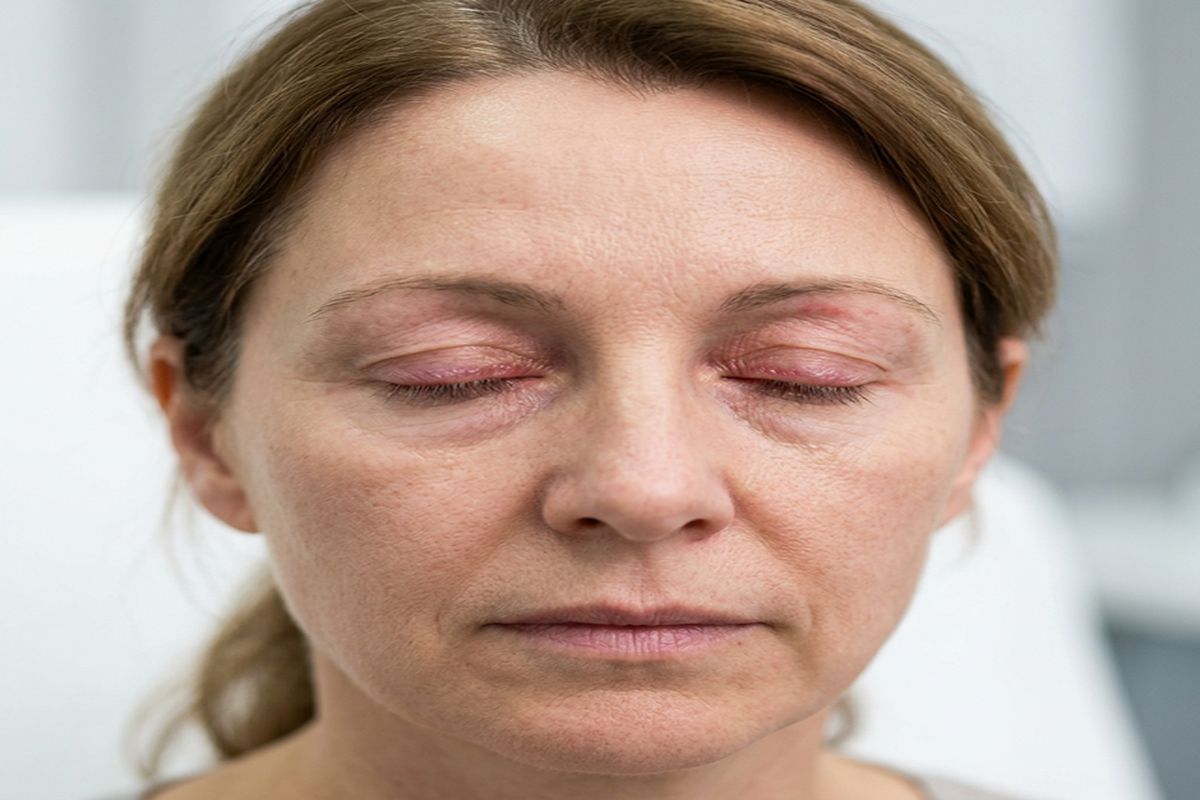
Blepharitis is one of the most common eye conditions, affecting an estimated 37–47% of people seen by eye care professionals. It’s a chronic inflammation of the eyelid margins, the edges of the eyelids where lashes grow, and it makes the skin there sensitive, easily irritated, and prone to bacterial overgrowth.
For regular eye makeup wearers, blepharitis raises obvious questions. The answer isn’t “stop wearing makeup”, it’s “make informed choices about what you put near your eyes and how.”
What Blepharitis Does to the Eye Area
Blepharitis comes in two main forms:
Anterior blepharitis affects the outer eyelid margin at the base of the lashes. Usually associated with staphylococcal bacteria or seborrhoeic dermatitis. Symptoms: scaling and crusting at the lash roots, lash loss in chronic cases, redness along the marginal edge.
Posterior blepharitis affects the inner edge of the eyelid, where the meibomian glands open into the tear film. Usually associated with meibomian gland dysfunction. Symptoms: gland capping (visible white dots at the gland openings), poor-quality tears, dry eye symptoms, intermittent styes.
Both affect how makeup sits on the eye area, how the tear film interacts with product, and how safely certain formulas can be applied near the lash margin.
Products That Worsen Blepharitis
Fiber-Extending Mascaras
Synthetic fibers in mascara formulas dislodge with blinking and can enter the tear film, irritating already-inflamed lid margins and potentially clogging meibomian gland openings. This is the highest-risk mascara category for blepharitis.
Eyeliner on the Waterline
Kohl, kajal, or any liner applied inside the waterline deposits product directly on the gland openings. In clinical studies, this has been shown to reduce tear film stability and increase meibomian gland dropout with long-term use. People with posterior blepharitis in particular should avoid all waterline liner.
Pencil Eyeliner (Near Lash Roots)
Wax-based pencil liners applied against the lash line can transfer product into the meibomian gland openings during application. Over time, waxy residue in gland openings is associated with gland blockage and reduced oil production. If you use pencil liner, apply it slightly above the lash root rather than against it.
Preservative-Containing Drops Used with Eye Drops
Many people with blepharitis use artificial tears to manage dry eye symptoms. Preserved drops (those containing benzalkonium chloride) can degrade the tear film lipid layer, especially problematic when combined with makeup. If you use artificial tears alongside eye makeup, preservative-free unit-dose drops are preferable.
Shared Makeup Tools
Blepharitis involves bacterial colonization (Staphylococcus epidermidis primarily) and sometimes Demodex mite infestation of the lash follicles. Sharing mascara wands, eyeliner pencils, or brushes transfers this colony profile to others and recontaminates your own tools with fresh bacteria. Never share eye makeup, and replace your own regularly.
Safer Makeup Choices for Blepharitis
Tube Mascara
The same guideline that applies to contact lens wearers and ocular rosacea applies to blepharitis: tube mascaras are the safest mascara format. They produce no fibers, don’t smear into the tear film, and remove cleanly without heavy rubbing. This single swap eliminates most mascara-related blepharitis aggravation.
Gel or Liquid Liner (Outer Lash Line Only)
A film-forming liquid or gel liner applied to the outer lash line, not the waterline, minimizes particle migration into the tear film while allowing definition. Dry completely before opening eyes wide.
Minimal Ingredient Eye Primers
If you use an eye shadow primer, choose one with a simple ingredient list without fragrance. The less product sitting on sensitive lid margin skin all day, the better.
Pressed Matte Eyeshadow
Matte pressed shadows produce less fallout than loose or shimmer shadows. Applied above the crease with a clean brush, they’re well-tolerated. Avoid applying dark shadow directly on the lid close to the lash line during flares.
Daily Hygiene: The Non-Negotiable Foundation
For blepharitis, lid hygiene is the core treatment, not the makeup choices. The best makeup approach in the world doesn’t replace this step:
Warm compress: Apply a warm damp cloth (or a dedicated heated eye mask designed for blepharitis) to closed eyelids for 5-10 minutes. The warmth softens any hardened meibum (oil) in the gland openings.
Lid scrub: After the warm compress, use a cotton round, diluted baby shampoo, or a dedicated blepharitis lid scrub product to gently massage along the lash margin. This removes debris, excess bacteria, and loosened gland secretions.
Frequency: Most ophthalmologists recommend this routine once or twice daily during symptom periods, and at least several times per week for maintenance.
Makeup consideration: Perform lid hygiene after removing makeup at night. Don’t apply lid scrubs over makeup, they’re designed for clean skin.
Makeup Removal for Blepharitis
The removal step is where many blepharitis patients inadvertently worsen their condition:
Avoid rubbing. Rubbing the eye area during makeup removal dislodges lash debris, spreads bacteria, and physically irritates inflamed lid margins. Use the “press and hold” technique: saturate a cotton pad, press gently over the closed eye for 10-15 seconds, then wipe gently.
Micellar water: the gentlest effective solvent for non-waterproof formulas. Use a formula without alcohol or fragrance.
Avoid acetone-based removers near the lash line. These are effective but too aggressive for inflamed margins.
Remove completely. Leaving even small amounts of mascara or liner at the lash base provides an organic substrate for bacterial growth overnight. Complete removal, verified in the mirror, is essential.
Follow immediately with lid hygiene: treat the nightly makeup removal as step 1 of your lid hygiene routine, not a separate process.
During Flares: When to Stop Wearing Makeup
Active blepharitis flares usually present with increased redness, crusting at the lash base, sticky discharge, or stye formation. During an active flare:
- Stop wearing eye makeup until symptoms settle (usually 2-7 days with proper hygiene)
- Don’t attempt to cover symptoms with concealer or foundation near the lash line
- Focus on lid hygiene and warm compresses, possibly with any prescribed antibiotic drops or ointments
- Discard and replace mascara and eyeliner used during the flare period, assume bacterial contamination
Continuing to apply eye makeup during a flare introduces new bacteria and product residue into an already-infected environment, prolonging the episode.
Long-Term Management
Blepharitis is chronic, not curable. The goal is management, keeping bacterial load low, meibomian glands functional, and the inflammatory response at baseline.
People with well-managed blepharitis can wear eye makeup indefinitely. The formula choices above, combined with consistent lid hygiene and clean brush habits, keep most patients comfortably in makeup with minimal flare frequency.
If you find you can’t maintain this balance, repeated flares despite careful hygiene and product selection, a specialist evaluation is worthwhile. Demodex-related blepharitis responds to different treatment (tea tree oil-based products or in-office Intense Pulsed Light treatment) than bacterial or seborrhoeic forms.
Sources
- American Academy of Ophthalmology, Blepharitis overview and treatment guidelines (2024)
- Geerling, G. et al. “The International Workshop on Meibomian Gland Dysfunction.” Investigative Ophthalmology & Visual Science, 2011
- Goto, E. et al. “Cosmetics applied to the eyelid margin and tear film stability.” Cornea, 2010
- Maissa, C. et al. “Eyelid margin product use and meibomian gland assessments.” Contact Lens & Anterior Eye, 2014
- National Eye Institute, Blepharitis prevalence and clinical description (2023)
Related Articles
- Smokey Eye Tutorial for Beginners
- Eyeshadow Blending Techniques
- Best Eyeshadow Palettes
- How to Make Eyes Look Bigger
- Eyebrow Shaping Guide
We evaluate beauty products and techniques independently. To learn more about our editorial standards, read our Editorial Policy.
Get weekly eye care & beauty tips
Guides from the Eyeshadow Looks Beauty Desk. No spam, ever.
Frequently Asked Questions
Can you wear mascara with blepharitis?
Yes, with the right formula. Tube mascaras are the best choice for blepharitis, they don't shed fibers or flake, and they rinse off without rubbing. Avoid fiber-extending mascaras and waterproof formulas that require acetone-based removers, which aggravate already-inflamed lid margins.
Is it okay to wear eyeliner with blepharitis?
Liner on the outer lash line is generally tolerated. Waterline liner (on the inner waterline) should be avoided, it places product directly on the lacrimal gland margin and meibomian gland openings, increasing gland blockage risk. Gel or waterproof outer-line liner is preferable to pencil, which sheds more particles.
Should you stop wearing makeup if you have blepharitis?
Not necessarily. Many people with blepharitis continue wearing eye makeup without significant problems by following safe product and hygiene protocols. However, during a flare, active swelling, crusting, or discharge, it's best to take a break until symptoms settle, then reintroduce products one at a time.