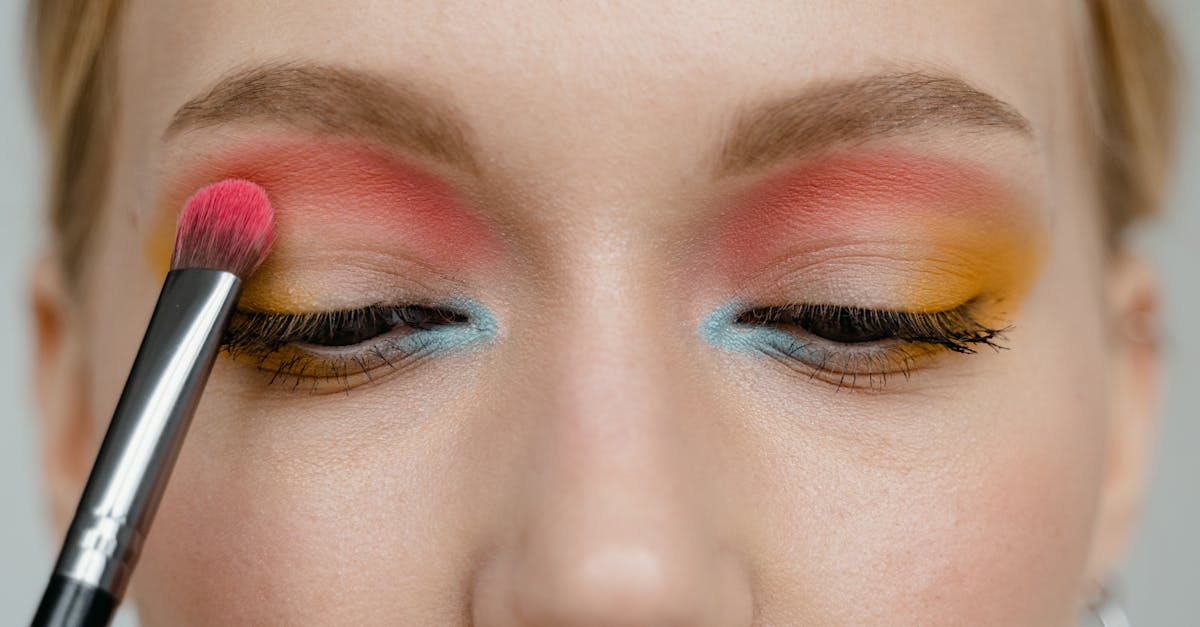
Downturned eyes have a naturally soft, gentle appearance. The outer corners sit lower than the inner corners, which some people love and others want to optically lift. These techniques specifically address the lifting effect, redirecting the eye’s apparent angle without anything permanent.
Identifying Downturned Eyes
Hold a pencil horizontally across your eye area. If the outer corner of your eye falls below the pencil’s line while the inner corner is on or above it, your eyes are downturned. This can be slight (just a few degrees off) or quite pronounced.
Downturned eyes often show more skin at the outer upper eyelid area because the outer corner slopes away. This is actually useful for makeup, it gives you more space to work with at the outer corner.
Eyeshadow Placement to Lift
Redirect the Crease Upward at the Outer End
Standard rounded crease blending follows the natural shape of the eye, for downturned eyes, this means your blending ends up pulling the eye downward. Instead:
Angle the outer end of the crease blend upward: When you reach the outer corner with your crease shade, don’t follow the lid downward. Push the shadow up and slightly outward toward the tail of the brow. This creates an upward arc in the blending that redirects the eye’s visual direction.
Think of it as a modified “C” shape with the bottom of the C lifted to angle upward, not downward.
Apply Deeper Shade Above the Outer Corner (Not Below)
For downturned eyes, placing your darkest shadow on the outer upper lid, slightly above and outside the outer corner, creates a visual “anchor” point that’s higher than the natural corner. This optically improves where the eye appears to end.
Avoid placing dark shadow below the outer corner on the lower lash line at the outer edge, as this emphasizes the downward slope.
Keep the Lower Lash Line Light
For the lower eye:
- Apply a soft matte shadow only to the middle section of the lower lash line
- Keep both the inner corner and outer corner of the lower lash line free of dark shadow
- Alternatively, leave the lower lash line completely bare, this is a high-lifts approach that removes any lower-edge weight
Liner Techniques for Downturned Eyes
The Upward-Angled Wing
This is the most effective single technique for downturned eyes.
How to do it:
- Apply liner along the upper lash line as normal, keeping it thin
- When you reach the outer corner, do not follow the lid’s downward slope, stop before the lid dips
- Extend the liner from the last lash outward and upward at an angle toward the brow tail
- The wing tip should point toward the outer end of the brow (roughly 30–45 degrees upward from horizontal)
The wing doesn’t correct the actual eye shape, it creates a directional visual cue pointing up, which overrides the eye’s downward direction.
Where to end the liner on the upper lid: Stop applying liner before you reach the very outer corner if that corner dips significantly. Starting the wing before the corner means the wing can go upward rather than having to fight against the downward slope.
Lower Liner: Avoid the Outer Corner
If you want lower lash line definition:
- Use a soft brown shadow on the inner two-thirds of the lower lash line only
- Leave the outer corner clean, adding liner there pulls the eye down
- Or use a light/nude liner on the lower waterline to open the eye without adding downward weight
Brow Tips for Downturned Eyes
The brow position relative to the eye significantly affects how downturned the eye reads.
Push brow arch toward the outer third: An arch that peaks at the outer portion of the brow creates upward movement above the outer eye area that counterbalances the downward outer corner.
Trim or lighten the tail of the brow: Brow tails that also angle downward reinforce the overall downward direction. A shorter or lighter brow tail keeps the outer face from reading as droopy at two points (brow and eye corner).
Avoid overly flat brows: A flat brow with no arch removes the upward counterpoint above the eye and makes the downturned corner more prominent by comparison.
Complete Lifting Technique: Step by Step
- Apply primer
- Blend transition shade in crease, angle the outer end upward toward brow tail
- Apply lid color to mobile lid
- Place deeper shade at outer corner, above rather than following the corner downward
- Apply upward-angled wing that redirects direction up and outward
- Apply mascara on upper lashes, curl thoroughly for extra lift
- Leave lower lash line light or bare at outer corner
Quick Reference
| Zone | What to Do | What to Avoid |
|---|---|---|
| Crease outer edge | Angle upward toward brow tail | Rounding down to follow corner |
| Outer shadow | Place above outer corner | Below outer corner |
| Lower lash line | Inner half only, or bare | Outer corner shadow or liner |
| Upper liner | Upward-angled wing | Following natural downward corner |
| Lower waterline | Nude or bare | Dark liner at outer corner |
| Brows | Arch toward outer third | Flat or downward-angled tails |
Related Guides
- Fox Eye and Siren Eye Tutorial
- Eyeliner to Make Eyes Look Bigger
- Eyeliner Tutorial: Every Type Explained
- Round Eyes Makeup Guide
- Almond Eyes Makeup Guide
Choosing the Right Product for Your Needs
When exploring eye makeup, selecting the perfect product relies heavily on understanding your skin type, undertones, and daily routine. To achieve the most flattering look, always prioritize formulas that work with your unique biology rather than against it.
Understanding Skin Types and Formulas
If you have oily eyelids, powder eyeshadows and waterproof liquid liners will be your best defense against midday creasing and smudging. For those with mature or dry skin, cream shadows and hydrating concealers offer a youthful, radiant finish that won’t settle into fine lines. Always start with a high-quality eye primer to ensure whatever formula you choose locks in place for 12+ hours. Also, applying setting powder lightly over the lids before packing on color can absorb excess sebum throughout the day, significantly extending the life of your look.
The Role of Undertones
Matching your makeup to your undertone is crucial. If you have cool undertones (veins appear blue/purple), reach for icy silvers, cool taupes, and berry hues. If your undertones are warm (veins appear green), gold, peach, bronze, and warm terracotta shades will make your eyes pop. Neutral undertones have the flexibility to wear almost any shade on the color wheel. Remember that contrasting colors on the color wheel create the most dramatic impact; for example, warm copper tones will make blue eyes appear vividly bright, while violet hues beautifully enhance green eyes or hazel eyes.
Proper Removal and Eye Health
The most important step of any makeup routine is removing it. Sleeping in eye makeup can lead to clogged hair follicles, lash loss, and severe eye infections like styes. Use a dedicated, gentle bi-phase makeup remover on a cotton pad, holding it over the closed eye for 10 seconds to dissolve waterproof bonds before gently wiping away. Never violently scrub the delicate skin around the eyes, as this accelerates premature aging and wrinkle formation. After removal, applying a hydrating, peptide-rich eye cream will restore the moisture barrier stripped away by cleansing surfactants, promoting healthy lash growth and a smoother canvas for the next day’s application.
Sources
- Face Forward, Kevin Aucoin (Little, Brown, 2000)
- Charlotte Tilbury Makeup Masterclass, Eye shape technique guides
- NikkieTutorials, Downturned eye tutorial (YouTube 2022)
Get weekly eye care & beauty tips
Guides from the Eyeshadow Looks Beauty Desk. No spam, ever.
Frequently Asked Questions
How do I know if I have downturned eyes?
Downturned eyes have outer corners that angle downward, lower than the inner corner. To check: hold a straight edge (like a pencil) horizontally across the face at eyelid level. If the outer corner of the eye falls below the line while the inner corner sits on or above it, your eyes are downturned. The effect can range from subtle to quite pronounced.
What eyeliner should I avoid with downturned eyes?
Avoid liner that follows the natural outer corner of the eye downward, this reinforces the downward angle and makes the eyes appear more droopy. The specific things to avoid: downward-angled wings that follow the outer corner direction, heavy lower liner at the outer corner that pulls the eye down, and surrounding the eye entirely in dark liner, which emphasizes the lower outer corner.
What is the best wing style for downturned eyes?
For downturned eyes, the wing should angle upward, not following the natural outer corner angle, but actively pointing upward toward the tail of the brow. Start the wing from the lash line before the outer corner begins to dip, and direct the flick upward at roughly a 30-45 degree angle. This redirects the eye's visual direction upward and counters the downward drift of the outer corner.